
Why Does My Dryer Shut Off Mid-Cycle and Start Again After It Cools Down?

General Appliance Service • October 11, 2026

Share this article

By General Appliance Service

A dryer that tumbles normally, stops partway through a load, and works again after sitting can be signaling a heat- or load-related problem. Unlike a sensor cycle that merely ends early, a full shutdown followed by a cooldown restart may involve airflow, the drive system, electrical connections, or controls. The pattern is useful, but it does not identify one failed part. Accurate diagnosis helps avoid unsafe use and unnecessary replacement parts.

What a Technician Checks When a Dryer Shuts Off Mid-Cycle

A technician first determines what actually stopped. Did the drum stop turning, did the display go blank, or did the drum continue while heat stopped? Those details help isolate the affected circuit.

A drive motor may overheat and open its internal thermal overload, then run again after cooling. However, the motor may be overheating because of a restricted blower, lint buildup, a binding belt or drum component, or motor wear. The power cord, terminal block, wiring connections, timer, and electronic control may also require testing.

For homeowners needing dryer repair in Palm Coast, noting exactly what happens at shutdown is more useful than guessing which part failed.

Airflow Problems Can Add Heat and Motor Load

Restricted airflow can contribute to overheating, long dry times, and extra stress on internal components. Moist air must move through the lint screen, blower housing, vent pipe, and exterior exhaust hood. When that path is limited, heat and moisture remain in the dryer longer.

Clean the lint screen before every load. A screen that appears clean but does not pass water easily may have residue from dryer sheets or fabric softener. Wash it gently with dish soap, rinse it, and let it dry before reinstalling it.

Check the outside exhaust hood while the dryer runs normally. Its flap should open and airflow should be present. Remove only loose, accessible debris. Do not vent the dryer indoors or run it indefinitely with the vent disconnected; both practices can create lint, moisture, and safety concerns.

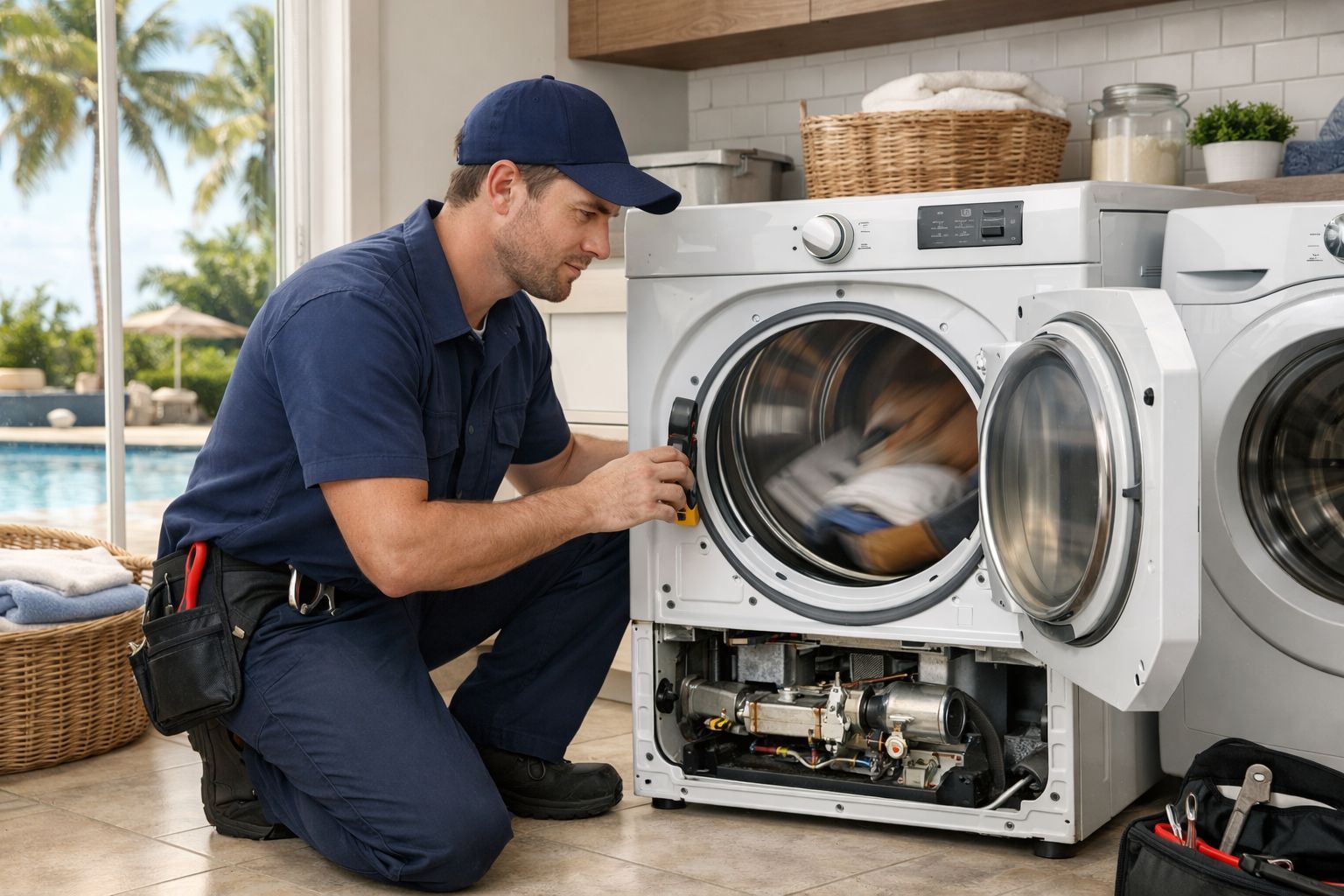
Illustrative appliance diagnostic inspection
AI-generated illustration of an appliance inspection.

Door, Power, and Electrical Interruptions Need Attention

An intermittent door switch or latch can stop a cycle if vibration makes the dryer register an open door. Notice whether the door closes firmly or whether gentle pressure on the closed door changes operation. Do not bypass the switch or defeat the door safety mechanism.

A loose harness, damaged cord, weak outlet connection, or supply problem can also cause intermittent operation. Electric dryers use high-voltage power, while gas dryers have separate ignition and control circuits. Opening panels or probing live voltage is not a safe homeowner test.

Stop using the dryer if the plug or outlet feels hot, a breaker trips, the cord is damaged, or there is a burning electrical smell, smoke, repeated overheating, or a gas smell. Washer and dryer repair can address intermittent laundry problems that need testing rather than parts-swapping.

Sensor-Dry Ending Early Is a Different Symptom

A dryer can seem to shut off early without experiencing a true mid-cycle failure. On an automatic or sensor-dry setting, it may end normally while the drum, display, and controls otherwise work as expected. Damp clothing after an early sensor-cycle finish can involve moisture-sensor contact, load size, leveling, airflow, temperature sensing, or control behavior.

Compare a timed cycle with a normal mixed load on sensor dry. Record how long each cycle runs, whether the dryer stops completely, and whether clothes remain damp. This does not prove a bad sensor, but it helps distinguish an automatic-cycle issue from a total loss of operation.

For nearby homeowners, Flagler Beach appliance repair can help identify whether the concern involves sensing, airflow, power, or the drive system.

Frequently Asked Questions About a Dryer That Shuts Off Mid-Cycle

Why does my dryer stop after 20 minutes and work later?

A cooldown restart can suggest motor overload protection, but restricted airflow, drive-system drag, loose wiring, or controls may also be involved.

Can a clogged dryer vent stop a dryer mid-cycle?

A restricted vent can trap heat and increase dryer workload. It may contribute to shutdowns, but the blower, motor, wiring, and controls also need evaluation.

Why does it stop only on sensor dry?

That usually suggests an automatic-cycle issue rather than a complete shutdown. Sensor contact, load composition, airflow, temperature sensing, or control logic may affect operation.

Should I keep restarting a hot dryer?

No. Stop using it if it is unusually hot, smells like burning rubber or insulation, trips a breaker, has a hot plug, produces smoke, or smells like gas.

What should I tell a dryer technician?

Share the selected cycle, load type, shutdown time, cooldown time before restart, display behavior, odors, noises, and any breaker trips.

Careful observations help a technician reproduce intermittent failures and test the most likely causes efficiently. Avoid repeated restart attempts when heat, electrical symptoms, or gas odors are present.

Recent Posts

By General Appliance Service • November 18, 2026
Learn why a gas dryer heats then blows cold air later in the cycle, what burner cycling is normal, and when delayed heat loss needs diagnosis.
By General Appliance Service • November 17, 2026
Is your electric oven taking too long to preheat? Learn what can cause slow heating, why the display may be misleading, and when professional diagnosis is needed.
Washer fills with water when turned off
November 16, 2026
Why does your washer fill with water when turned off? Learn how inlet-valve seepage differs from drain backflow, what to shut off safely, and when to call a technician.
By General Appliance Service • November 15, 2026
Learn why a front load washer smells musty after cleaning, what homeowners can safely check, and when drainage or residue problems need professional diagnosis.
By General Appliance Service • November 14, 2026
An electric stove burner that stays on high is a temperature-control problem. Learn what may cause it, what to check safely, and when to stop using the range.
By General Appliance Service • November 13, 2026
A refrigerator fan noise that stops when the door opens may involve normal fan timing, frost contact, or a failing motor. Learn what to check safely.
By General Appliance Service • November 12, 2026
A dishwasher knocking noise during the wash cycle may be caused by spray-arm contact or a wash-system problem. Learn what to check safely and when repair is needed.
By General Appliance Service • November 11, 2026
Gas dryer rattles only when heating? Learn what a heat-only buzz or chatter can indicate, what to check safely, and when to call for dryer repair.
By General Appliance Service • November 10, 2026
Learn why an oven display resets when heating, what homeowners can safely check, and when a heat-related power loss needs professional diagnosis.
By General Appliance Service • November 7, 2026
Washer leaving grease spots on clothes? Learn how detergent buildup, laundry contaminants, and internal washer problems can create dark marks.
Show More